History of Wengen

View from the Männlichen of snow-covered Wengen and the Lauterbrunnen Valley in winter.

The beginnings

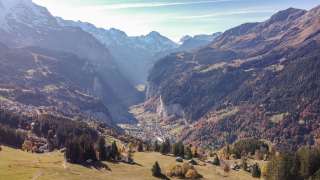
Wengen was first mentioned in 1268 in a deed of sale as ‘auf dem Berge Wengen’. The place name is probably the plural of the old word ‘Wang’, which refers to a more or less steep mountainside. The name thus describes the village’s location on the slopes above the Lauterbrunnen Valley.
In the Middle Ages, the Lauterbrunnen Valley initially belonged to various secular rulers. In the 14th century, large parts of the rights and possessions passed to Interlaken Abbey. After the Reformation, the area came under the rule of Bern. As early as the second half of the 16th century, Wengen had its own mountain school – an indication that a stable village community had developed on the high terrace.
For centuries, the population lived mainly from agriculture, livestock farming, alpine farming and forestry. The individual farms were widely scattered, and the steep paths down into the valley made contact with the surrounding villages difficult. Close cooperation within the village community was therefore particularly important for daily life.

The Development of Tourism

From the second half of the 18th century onwards, increasing numbers of travellers, naturalists and mountaineers began to visit the Lauterbrunnen Valley. The route from Lauterbrunnen via Wengen, the Wengernalp and the Kleine Scheidegg to Grindelwald was one of the classic journeys through the Bernese Oberland. At that time, however, Wengen could only be reached on foot or by pack animal.
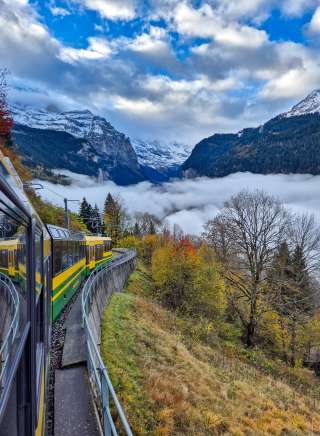
The decisive turning point came in 1893 with the opening of the Wengernalp Railway. The rack railway linked Lauterbrunnen via Wengen with Kleine Scheidegg and Grindelwald. This made it much easier for visitors to reach the Alpine village. At the same time, food, building materials and other goods could be transported more reliably. The new railway led to a sharp rise in visitor numbers and the construction of numerous hotels.
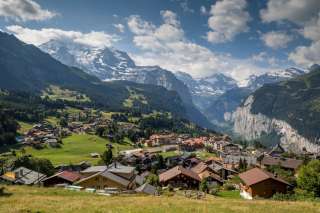
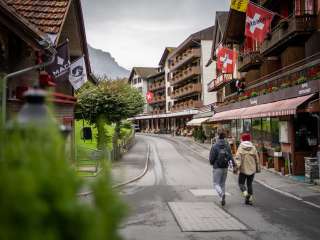
In the decades that followed, stately hotels, guesthouses and B&Bs were built. Wooden houses, chalets and hotels from the Belle Époque and Art Nouveau periods continue to characterise the town’s appearance to this day. A further boom was brought about by the Jungfrau Railway, which began operating as far as the Jungfraujoch in 1912. Wengen thus became an important starting point for journeys into the high-Alpine mountain and glacier world.

Winter sports and the Lauberhorn

Initially, Wengen was primarily a summer holiday resort. At the start of the 20th century, however, more and more visitors began to discover winter in the Alps. British visitors in particular helped to popularise skiing, curling and other winter sports in the region.
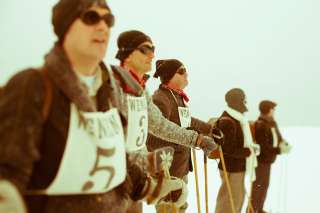
The Wengen Ski Club was founded as early as 1904. In 1921, the first British Ski Championships took place in Wengen, with an alpine downhill race forming part of the programme. The mountain railways served as an early means of transport for the skiers. In 1925, British visitors founded the ‘Downhill Only Ski Club’ in Wengen, which is now one of the oldest alpine ski clubs in Europe.
The International Lauberhorn Races have been held since 1930. The spectacular downhill run, featuring well-known sections such as Hundschopf, Kernen-S and Haneggschuss, has made Wengen famous worldwide. To this day, the races remain among Switzerland’s most significant winter sports events and are an important part of the village’s identity.
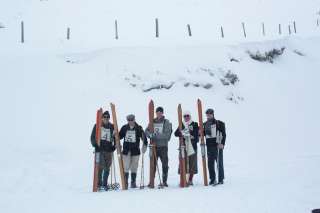
The history of skiing continues to be cherished in Wengen. The ski club, ski school, mountain railways and numerous volunteers pass on their experience to future generations and help ensure that Wengen remains an internationally renowned winter sports resort.

Traditions and customs

Despite its international appeal, Wengen has preserved many of its rural traditions. Alpine farming remains a visible part of village life. During the traditional descent from the Wengen Alp, the decorated animals parade through the village and are welcomed by locals and visitors alike.
Folklore evenings featuring traditional costumes, folk music, yodelling, dancing and cowbell ringing keep regional customs alive. The local dialect, the clubs and the close ties to mountain farming also shape the village’s cultural identity.
In addition, the historic hotels, the Wengernalp Railway, the British winter sports tradition and the Lauberhorn races have themselves become part of Wengen’s cultural heritage. They serve as a reminder of how closely the village’s history is linked to the development of Alpine tourism.

Wengen today

Today, Wengen is a modern holiday resort situated on a sunny terrace at 1,274 metres above sea level. The village is car-free and can only be reached from Lauterbrunnen by train, on foot or by cycle. As well as carrying passengers, the Wengernalp Railway also plays a key role in supplying the village.
Wengen offers a wide range of leisure activities in every season. In summer, the focus is on hiking, mountain tours, nature experiences and excursions to the Kleine Scheidegg or the Jungfraujoch. In winter, the main attractions are skiing, sledging, winter hiking and the Lauberhorn races.
Its car-free setting, the impressive views of the Eiger, Mönch and Jungfrau, and the blend of historic hotels, traditional timber-framed houses and modern tourist infrastructure give Wengen its distinctive character. The village thus combines its centuries-old history with forward-looking development and remains one of the most traditional holiday resorts in the Bernese Oberland.

Cela pourrait également vous intéresser